
Many buyers assume that newer homes are easier to resell. The logic seems straightforward. Newer homes typically offer modern layouts, updated finishes, improved energy efficiency, and fewer immediate maintenance concerns. If a home is newer, it should attract more buyers and sell more quickly when the time comes to move.
But does the data actually support that assumption?
To find out, I analyzed Calgary MLS® listing activity from the 12-month period ending May 31, 2026. Unlike many market studies that focus only on completed sales, this analysis included successful and unsuccessful listing outcomes.
The results challenged one of the most common assumptions in residential real estate.
Methodology The Assumption What the Data Shows Days on Market We Tried to Disprove It Buyer Takeaway Final Thoughts
For this analysis, Sold and Pending listings were treated as successful outcomes. Expired, Terminated and Withdrawn listings were treated as unsuccessful outcomes. Active listings were excluded because their final outcome remains unknown.
The Odds of Selling metric was calculated as:
(Sold + Pending) ÷ (Sold + Pending + Expired + Terminated + Withdrawn)
This methodology is consistent with the approach used in my Calgary market update reports.
A common belief among buyers is that newer homes carry less resale risk.
The reasoning is understandable. Newer homes often offer:
Many buyers assume these advantages naturally translate into stronger future resale performance.
The data suggests the relationship may not be quite so simple.
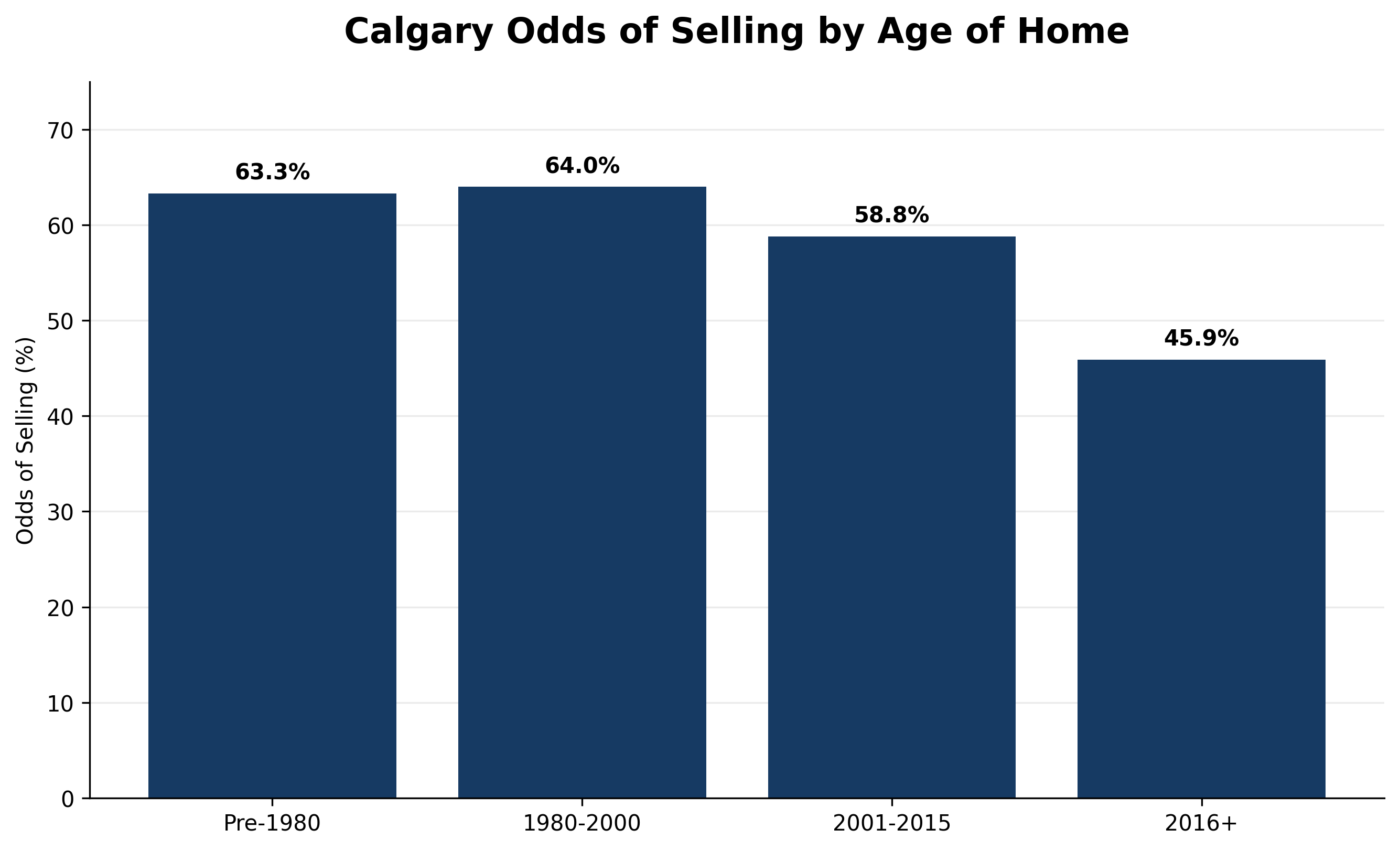
When listings were grouped by age of home and analyzed using the Odds of Selling metric, a surprising pattern emerged.
Homes built before 2000 achieved odds of selling of approximately 63% to 64%. Homes built between 2001 and 2015 achieved odds of selling of approximately 59%. Homes built after 2016 achieved odds of selling of just 45.9%.
That is a significant difference. In practical terms, recently built homes were materially less likely to result in a successful transaction during the study period than older homes.
At this point I expected the result might be explained by some other factor. So the next step was to investigate further.
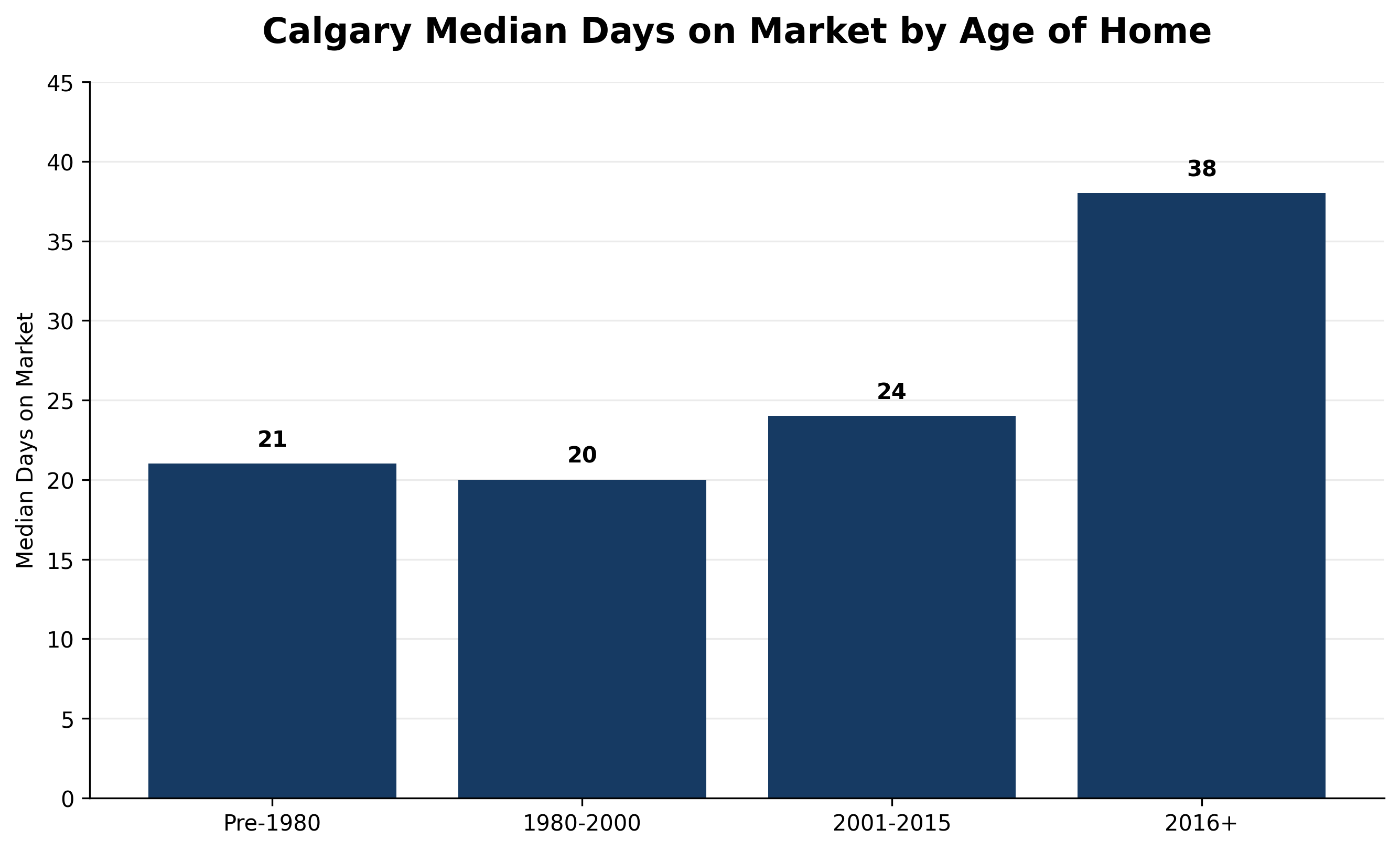
The odds-of-selling analysis was supported by a second measure: Days on Market.
Older homes generally sold within approximately three to four weeks. Recently built homes often remained on the market for noticeably longer.
This suggested the finding was not simply a statistical quirk. Newer homes were both less likely to sell and slower to sell.
However, before drawing conclusions, it was important to determine whether another factor was driving the result.
Whenever data produces a surprising outcome, the first question should be: could something else explain the result?
One possibility was that apartments were skewing the data.
That theory did not hold.
To determine whether the result was being driven by a single property type, the Odds of Selling calculation was repeated separately for detached, semi-detached, row and apartment properties.
The table below shows the percentage of listings that resulted in a successful outcome within each age category.
| Property Type | Pre-1980 | 1980-2000 | 2001-2015 | 2016+ |
|---|---|---|---|---|
| Detached | 65.9% | 65.0% | 61.3% | 45.1% |
| Semi-Detached | 67.9% | 73.5% | 68.0% | 53.8% |
| Row/Townhouse | 65.0% | 66.5% | 61.0% | 46.9% |
| Apartment | 49.7% | 56.3% | 52.4% | 42.1% |
Table 1: Odds of Selling by property type and age of home. Sold and pending listings were treated as successful outcomes. Expired, terminated and withdrawn listings were treated as unsuccessful outcomes.
The exact percentages vary by property type, but the pattern remains remarkably consistent. Homes built after 2016 recorded lower odds of selling across detached, semi-detached, row and apartment properties.
Another possibility was that newer homes are concentrated in rapidly growing communities where there is more competing inventory.
This explanation seemed plausible. Communities experiencing active development often have builder inventory, spec homes and multiple resale listings competing for the same buyers.
To test this theory, recently built homes located in growth communities were compared with recently built homes located elsewhere in Calgary.
If growth-community competition were the primary explanation, we would expect recently built homes in growth communities to show dramatically lower odds of selling than recently built homes in established communities.
That is not what the data showed.
While recently built homes in growth communities did exhibit somewhat lower odds of selling, the difference was much smaller than expected. More importantly, recently built homes outside of growth communities also showed relatively weak selling performance.
Growth-community competition may contribute to the pattern, but it does not appear to fully explain it.
Another possibility was that price was driving the result.
Recently built homes often command higher prices than older homes. If affordability were the primary explanation, we would expect the difference in selling performance to disappear once homes were compared within similar price ranges.
To test this theory, homes were grouped by both property type and price range.
The pattern largely persisted.
Detached homes, row homes and apartments frequently showed lower odds of selling for recently built properties even when compared with older homes at similar price points.
Price undoubtedly influences buyer demand. However, the analysis suggests that affordability alone does not fully explain why recently built homes were less likely to sell during the study period.
This was perhaps the most surprising finding.
If buyers were avoiding newer homes, one might expect them to sell only after substantial price reductions.
That was not the case. Recently built homes generally achieved sale-to-list ratios similar to older homes once they sold.
The challenge was not necessarily obtaining a reasonable price. The challenge appeared to be successfully attracting a transaction in the first place.
This analysis does not suggest that older homes are superior investments.
Nor does it suggest that recently built homes are poor purchases.
What it does suggest is that many buyers may overestimate the resale advantage associated with newer construction.
If future resale flexibility is important, factors such as community characteristics, competing inventory, buyer demand, housing supply and market positioning may be just as important as the year the home was built.
The most plausible explanation may be competition. A buyer considering a recently built home may have several alternatives available, including similar resale homes, builder inventory, spec homes, future development phases and competing projects nearby.
Many newer homes can appear relatively interchangeable from a buyer's perspective. Older homes often exist in a different environment. A renovated bungalow in Acadia, a character home in West Hillhurst, or an established property in Montgomery may have fewer direct substitutes available at any given time.
This does not necessarily make older homes better. It may simply make them less replaceable.
I began this analysis expecting newer homes to outperform older homes from a resale perspective.
The data suggested otherwise.
During the 12-month period ending May 31, 2026, recently built Calgary homes generally took longer to sell, recorded lower odds of selling, and did not require dramatically larger discounts once sold.
The lesson is not that buyers should avoid newer homes.
The lesson is that newer does not automatically mean easier to resell.
When evaluating long-term marketability, understanding the competitive landscape surrounding a property may be just as important as understanding the property itself.
If you are comparing newer homes with older resale properties, the year built is only one part of the decision. Community context, competing inventory, buyer demand and future marketability can all influence whether a specific home makes sense.
Buying: I can help you compare homes beyond the surface-level features and evaluate how each property may fit your long-term goals.
Selling: I can help you position your property within its actual competitive set rather than relying only on broad Calgary market averages.
Want a clearer read on a specific property or community?
Let’s talk.