
Not all Calgary communities behave the same way over time.
Some seem to remain consistently desirable across multiple market cycles, while others experience sharper swings in pricing, inventory, or buyer activity. That does not necessarily mean one community is “good” and another is “bad.” In many cases, communities simply attract different types of buyers and evolve in different ways over time.
After reviewing MLS® sales activity from January 1, 2016 through December 31, 2025 across several Calgary communities, one pattern stood out to me: some communities stay resilient because they appeal to a broad range of buyers, while others maintain value by continuing to attract the same highly specific buyer profile year after year.
In other words, Calgary communities do not all hold value for the same reasons.
Some maintain relevance through flexibility and evolution. Others maintain it through scarcity, prestige, or highly concentrated demand.
The difference becomes easier to see once you look beyond price growth alone and focus on how communities actually function over time. You can also explore additional Calgary community pages to compare how different areas, housing types, and neighbourhood structures perform across the city.
Broader Buyer Participation Scarcity and Specialization Community Evolution Beyond Price Growth Final Thoughts
One of the clearest patterns in the data was that communities with multiple active housing types often showed broader and more persistent market participation over time.
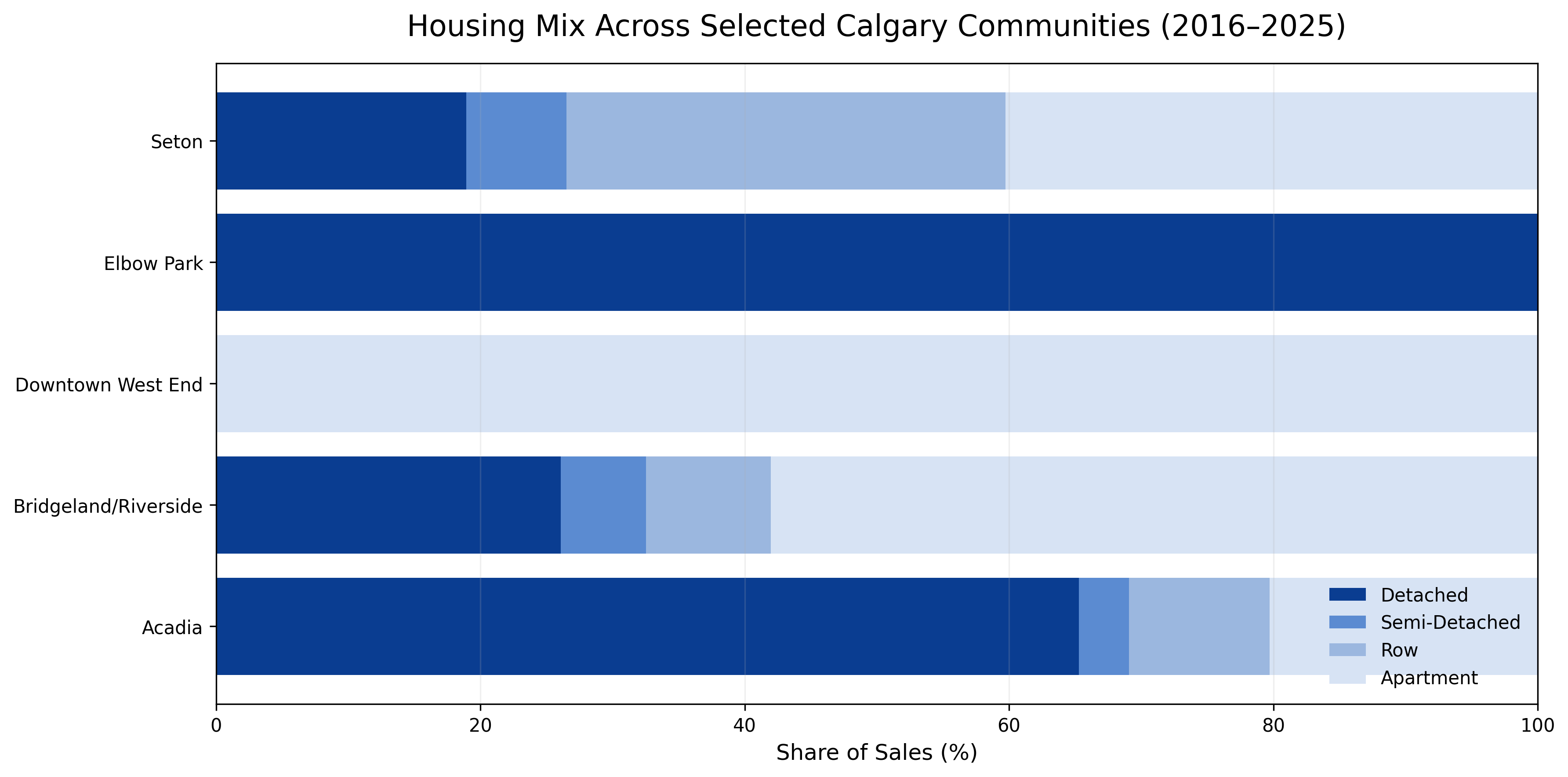
Bridgeland/Riverside was a strong example of this. Over the past decade, sales activity included detached homes, semi-detached properties, row homes, and apartments, with no single housing type fully defining the community. At the same time, the community continued evolving through redevelopment, infill activity, transit-oriented growth, and increasing density.
That broad mix of housing creates multiple entry points into the community. A buyer may enter through an apartment or townhouse, later move into a detached infill, and still remain within the same neighbourhood ecosystem. Investors, first-time buyers, professionals, downsizers, and higher-end infill buyers can all participate in the same area simultaneously.
Seton showed a different version of the same idea.
Unlike Bridgeland, Seton is still in a much earlier growth phase, but the data showed one of the most balanced housing mixes of any community reviewed. Detached homes, row homes, apartments, and semi-detached properties all contributed meaningful sales activity over the last decade. The community has also continued shifting toward higher-density housing over time as additional phases, commercial development, and apartment construction were added near the South Health Campus corridor.
What makes communities like Bridgeland and Seton interesting is not simply that they contain different housing types. It is that they continue attracting different types of buyers at different stages of life and across different price points.
That broad participation can help support consistent resale activity over time.
At the same time, the data also showed that housing diversity is not the only path to long-term stability.
Elbow Park demonstrated almost the exact opposite structure from communities like Bridgeland or Seton. Over the 10-year period analyzed, sales activity was overwhelmingly detached homes with virtually no participation from apartments, row housing, or semi-detached product.
Yet Elbow Park has remained one of Calgary’s most consistently desirable communities for decades.
The reason appears to be different. Instead of broad buyer participation, communities like Elbow Park rely more heavily on scarcity, prestige, lot quality, river proximity, mature landscaping, and a buyer pool specifically seeking that type of environment.
The number of potential buyers may be narrower, but the demand profile is also very durable.
Interestingly, Downtown West End showed another form of concentrated demand entirely. Unlike Elbow Park, nearly all sales activity consisted of apartments and condominiums. Even so, the area still demonstrated consistent transaction activity over time because it continues attracting a very specific urban buyer profile tied to downtown living, transit access, rental demand, and proximity to employment.
These communities are structurally very different from one another, yet both appear capable of maintaining long-term relevance through highly concentrated demand patterns.
That was one of the more interesting findings from the analysis.
Another pattern that stood out was how differently communities evolve over time.
Acadia was one of the clearest examples.
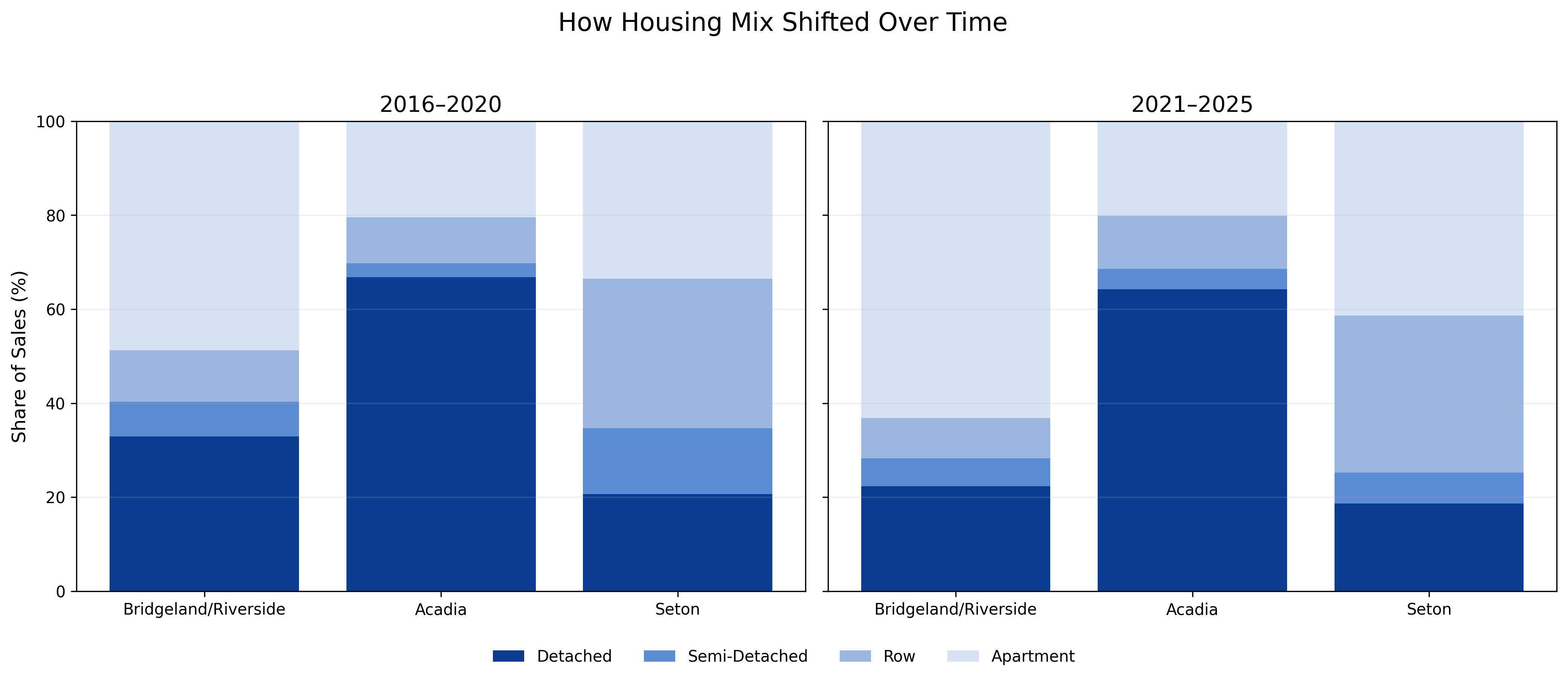
Historically, Acadia has been a detached-home dominated community built largely around post-war bungalow development. But over the last decade, the sales mix gradually broadened as row homes, semi-detached product, apartments, renovations, and redevelopment activity became more common.
Importantly, the transition was gradual rather than disruptive.
Acadia still feels like Acadia. The community did not suddenly lose its identity. Instead, it appears to be slowly broadening the range of buyers and housing options participating within it.
That type of gradual evolution may help mature communities remain relevant longer as buyer preferences, affordability constraints, and housing needs change over time.
Bridgeland showed a more accelerated version of this transition, with increasing apartment and row-home participation over the last decade alongside continued infill redevelopment. Seton showed yet another variation, evolving rapidly from a primarily detached suburban growth community toward a more mixed-density regional hub anchored by employment, commercial expansion, and higher-density housing.
Not every community evolves in the same way, and not every community needs to.
But the data does suggest that communities capable of adapting to changing housing demand may broaden the range of buyers participating within them over time.
When people talk about communities “holding value,” they often focus entirely on appreciation.
But in practice, there are several different ways a community can remain resilient.
Some communities show consistent resale activity across multiple housing types. Others maintain desirability through prestige and scarcity. Some evolve gradually as new housing forms are introduced. Others continue attracting highly concentrated buyer demand tied to a specific lifestyle or location advantage.
In many cases, resilience is less about which community rises the fastest and more about whether buyers continue showing up across changing market conditions.
That can show up through:
The mechanisms may differ, but the underlying theme is often the same: communities that continue attracting buyers year after year often remain more stable over time.
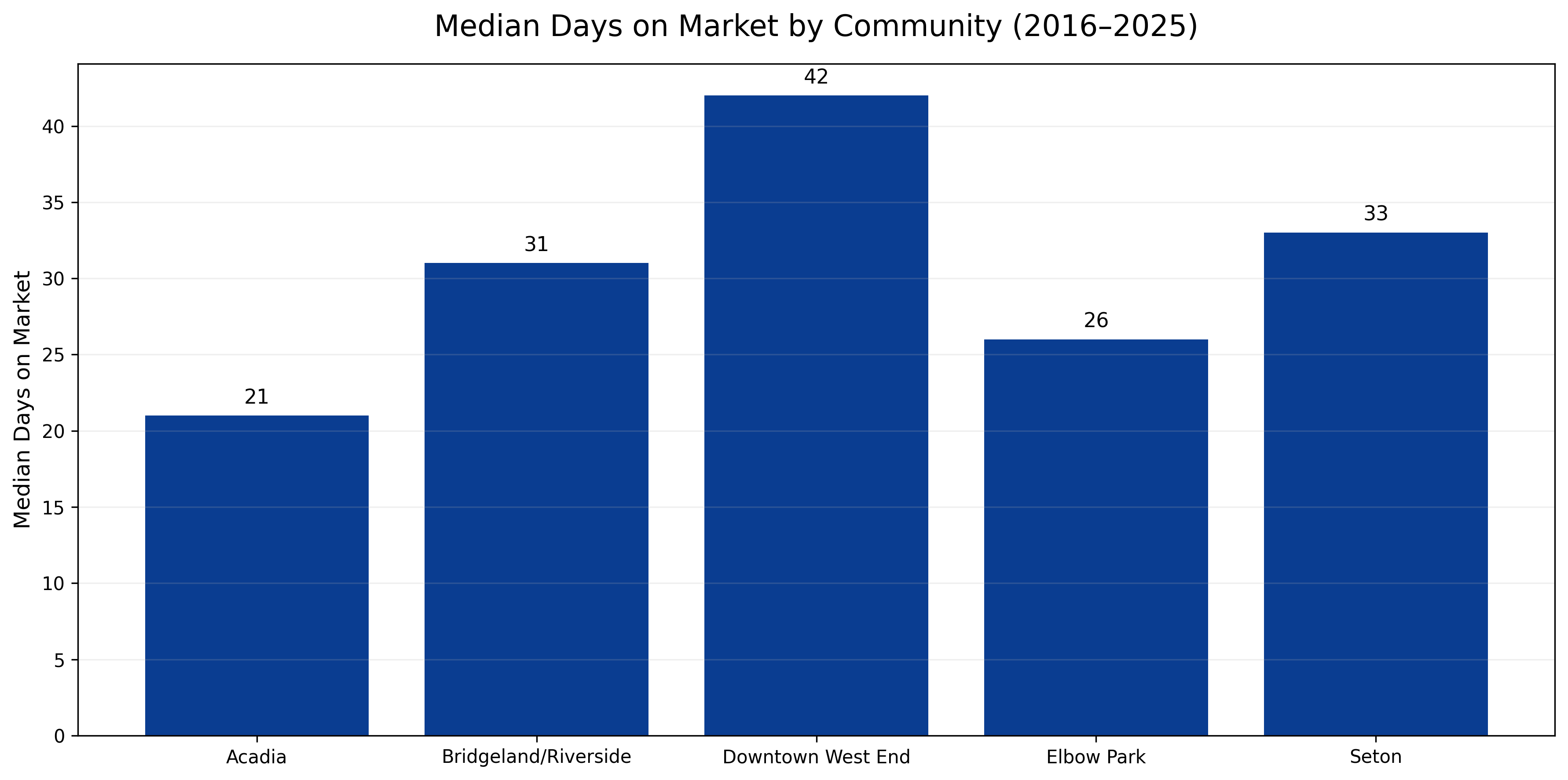
Interestingly, the communities analyzed also showed very different liquidity patterns. Acadia demonstrated relatively steady resale activity over the decade, while Downtown West End showed longer median selling times tied to a more apartment-focused urban market. Bridgeland and Seton fell somewhere in the middle, reflecting communities that continue evolving while still maintaining active buyer participation.
The differences matter because they reinforce the idea that communities do not all function the same way, even when they may appear strong on the surface.
One of the biggest takeaways from this analysis is that there is no single formula for what makes a Calgary community resilient.
Some communities maintain value through flexibility and housing diversity. Others do so through exclusivity, location, scarcity, or highly specialized demand. Some gradually evolve as buyer preferences change, while others remain remarkably consistent over decades.
Understanding those differences may matter more than simply trying to identify which community appreciated the most in a given year.
Because in the long run, communities are not just collections of homes. They are evolving ecosystems shaped by buyer behaviour, housing mix, redevelopment patterns, lifestyle preferences, and long-term desirability.
And the communities that continue attracting buyers — whether broadly or very specifically — often end up being the ones that remain most resilient over time. Buyers researching higher-density housing can also explore additional analysis and listings through our Calgary condos for sale hub.
If you are comparing Calgary communities, the headline price trend is only part of the story. The housing mix, buyer pool, resale activity, and long-term community appeal can all affect how a property performs over time.
Buying: I can help you compare communities based on more than price alone, including housing type, resale activity, and the type of buyer demand each area tends to attract.
Selling: I can help you position your property within the specific market dynamics of your community rather than relying only on broad citywide trends.
Want a clearer read on a specific Calgary community?
Let’s talk.